


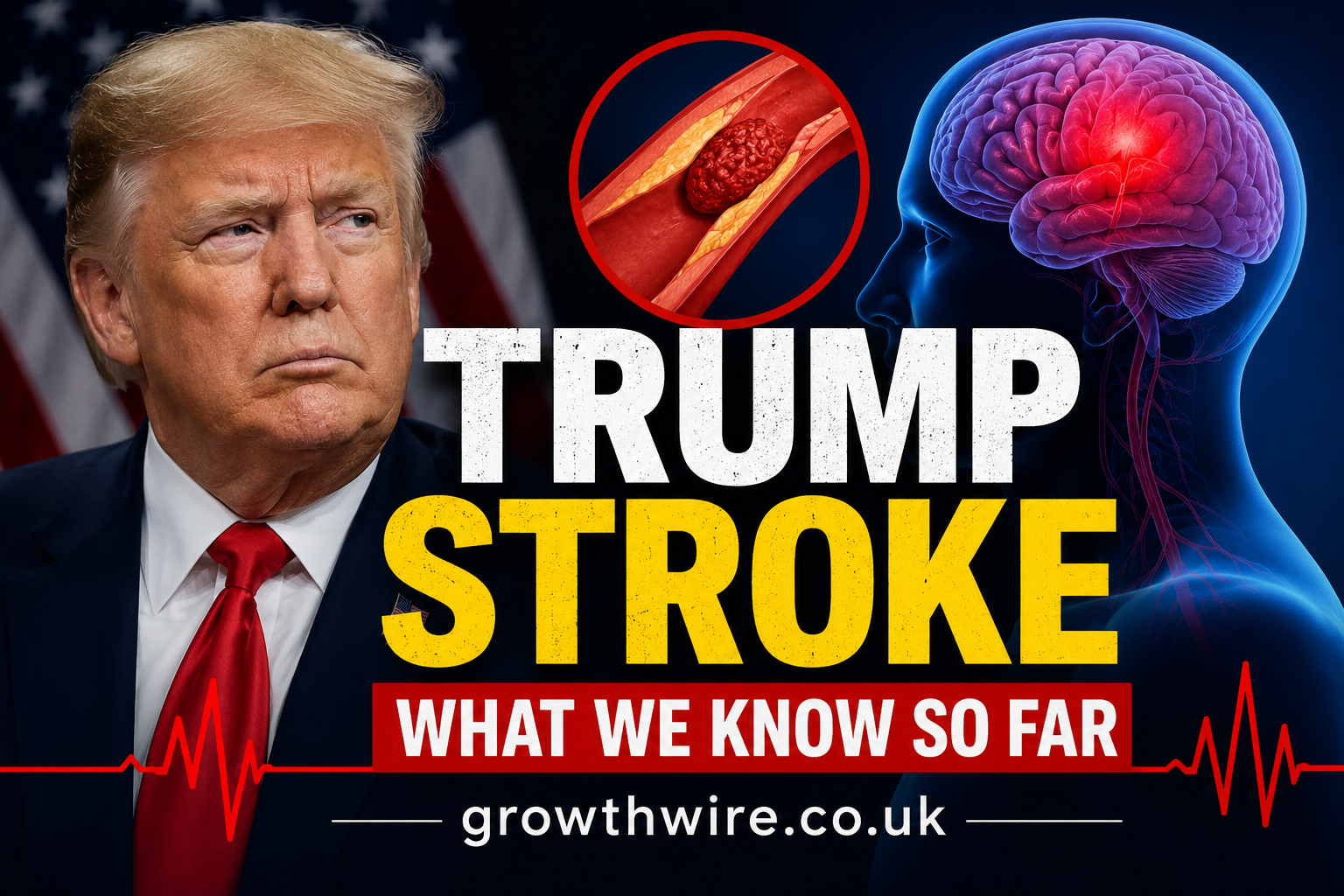
The phrase Trump stroke has become the kind of keyword people search when rumors, public appearances, and political curiosity collide. In a media environment where every facial expression, pause, or health-related headline gets amplified, it is easy for speculation to spread faster than facts. That is especially true when the subject is a president or former president, because the public naturally wants to know whether visible changes signal something serious. But a responsible discussion of Trump stroke should begin with a simple rule: a rumor is not a diagnosis, and online assumptions are not medical evidence.
As of the latest public reporting, there is no verified official report confirming that Donald Trump has had a stroke. Reuters reported in July 2025 that the White House attributed his leg swelling to chronic venous insufficiency and said an ultrasound found no signs of deep vein thrombosis or arterial disease, while a separate April 2025 physical was reported as showing no major health problems and that he was in excellent physical and cognitive health. Later reporting also noted that the White House declined to disclose specific details about a reported MRI, while still saying he remained in exceptional health.
That distinction matters. The public may be interested in Trump’s health, but the term Trump stroke should be handled carefully because it can imply a medical event that has not been confirmed. A fair article should therefore explain two things at once: what is publicly known about Trump’s recent health-related coverage, and what a stroke actually is. Only then can readers separate sensational speculation from medically meaningful information.
Trump Stroke: Why the Topic Keeps Returning
Searches around Trump stroke often spike for the same reason many celebrity-health rumors do: people notice something unusual in a photo, clip, or speech and try to explain it. A slowed pace, a facial expression, a bruise, or a brief pause can trigger a wave of online theories. In Trump’s case, health discussion has also been fueled by recent reporting about swelling, bruising, and additional medical imaging, all of which naturally invite questions from the public. Yet those questions do not automatically add up to a stroke. The leap from “something looks different” to “he had a stroke” is a classic example of speculation outrunning evidence.
This is one reason the keyword Trump stroke is so powerful in search results. It combines a highly recognizable political figure with a serious medical condition, which makes it emotionally charged. But the seriousness of the condition is exactly why the conversation should stay anchored in verified information. A stroke is not a vague feeling or a political insult. It is an acute medical emergency that happens when blood flow to part of the brain is blocked or when a blood vessel bursts.
What a Stroke Is and Why It Matters
A stroke occurs when the brain is deprived of oxygen-rich blood. That interruption can damage brain tissue quickly, which is why timing is so important. The CDC explains that strokes can happen when blood flow to the brain is blocked or when a vessel in the brain leaks or ruptures. The consequences vary depending on where the stroke happens and how much brain tissue is affected, but they can include paralysis, speech problems, vision loss, confusion, and long-term disability.
The major point for readers is that stroke is not something that can be confirmed by casual observation alone. A person might look tired, have trouble speaking for many reasons, or appear unsteady because of fatigue, medications, dehydration, or another medical issue. That does not mean a stroke has occurred. Medical professionals use examination, imaging, and other tests to determine whether a stroke or another condition is responsible.
In public life, however, that nuance often gets lost. A keyword like Trump stroke can create the impression that there is a known event behind the search. In reality, the term may reflect public anxiety, political bias, curiosity, or a mix of all three. That is why it is useful to step back and focus on the medical facts rather than the noise around them.
Trump Stroke Rumors and the Limits of Online Diagnosis
One of the biggest problems with Trump stroke rumors is that people often confuse visible symptoms with a confirmed cause. A person may have a bruised hand, swollen ankles, or look different in certain lighting, and social media can quickly turn those observations into a serious diagnosis. Yet the White House said Trump’s July 2025 leg swelling was due to chronic venous insufficiency, a common vein condition, not stroke. Reuters also reported that the hand bruising was attributed to frequent handshaking and aspirin use. Those are far more ordinary explanations than the dramatic theory that the internet often prefers.
This matters because stroke symptoms are specific. The CDC and the National Institute of Neurological Disorders and Stroke list warning signs such as sudden face drooping, arm weakness, speech difficulty, confusion, trouble seeing, trouble walking, dizziness, and severe headache. These are not the same as ordinary aging or generic tiredness. If those symptoms appear suddenly, they require immediate emergency attention.
The problem with rumor-driven coverage is that it can flatten all health issues into one dramatic headline. A search phrase like Trump stroke may generate content that sounds authoritative while resting on weak assumptions. Responsible readers should ask: Was there a doctor’s statement? Was there imaging? Was there a hospital report? Is the claim based on a reliable source, or just on a clip taken out of context? Those questions separate evidence from entertainment.
Trump Stroke: Symptoms People Should Actually Watch For
A useful discussion of Trump stroke should also educate readers about the real warning signs of stroke, because public fear can become constructive only when it leads to better awareness. The CDC recommends remembering that symptoms usually appear suddenly. These include numbness or weakness in the face, arm, or leg, especially on one side; confusion; trouble speaking or understanding speech; trouble seeing; dizziness; loss of balance; and a sudden severe headache with no known cause.
The American Heart Association promotes similar warning signs through F.A.S.T. and B.E. F.A.S.T. campaigns. F.A.S.T. reminds people to look for Face drooping, Arm weakness, and Speech difficulty, and then call emergency services immediately. B.E. F.A.S.T. adds Balance loss and Eye changes. The key word in every campaign is time, because fast treatment can reduce the chance of permanent brain damage.
This is why a proper article on Trump stroke should not sensationalize the issue. It should help readers recognize what a stroke looks like in real life. If someone suddenly has a lopsided smile, cannot raise one arm normally, or begins speaking in a slurred or confused way, that is an emergency. Waiting to “see if it passes” can be dangerous.
Risk Factors That Matter More Than Speculation
When people hear the phrase Trump stroke, they often look for a single dramatic cause. Medicine is usually more complicated than that. The CDC identifies high blood pressure as a leading cause of stroke, and also lists factors such as high cholesterol, smoking, diabetes, heart disease, obesity, physical inactivity, and unhealthy diet among the major risks. Age also increases risk, but age alone does not prove a stroke has happened.
For public figures, risk factors can become a magnet for speculation. If someone is older and politically prominent, viewers may assume that every visible change is a sign of a major neurological event. But medical risk is not the same as medical fact. Someone can be at higher risk of stroke without actually having had one, and someone can have a health issue entirely unrelated to the brain. That is why the difference between a risk factor and an event matters so much in discussions around Trump stroke.
In Trump’s case, public reporting has focused more on vein-related swelling, bruising, aspirin use, and later imaging questions than on any confirmed neurological emergency. Those details may explain why the rumor gained traction, but they do not establish a stroke diagnosis. Readers should resist the temptation to convert incomplete information into certainty.
Why Age Alone Does Not Prove a Trump Stroke
Age is one of the easiest factors for the public to overread. It is true that stroke risk increases with age, and that older adults need to pay close attention to blood pressure, circulation, and other health markers. The CDC says stroke risk increases with age, but it also stresses that strokes can occur at any age. So while age can raise concern, it cannot diagnose anything by itself.
This distinction is important in political media coverage. When a leader is older, critics and supporters alike may scrutinize every health rumor. Yet a fair discussion of Trump stroke should avoid ageist shortcuts. A person may look different on a given day because of travel, stress, fatigue, medication, lighting, or routine illness. None of those observations proves a stroke. A serious claim deserves serious evidence.
That is also why verified medical updates matter. Reuters reported that Trump’s April 2025 physical was described by the White House physician as showing no major problems and excellent physical and cognitive health. Later, the White House disclosed chronic venous insufficiency as the explanation for leg swelling. Those reports are not proof that nothing can ever change, but they do show that public speculation should not outrun official medical information.
How Doctors Evaluate a Suspected Stroke
A meaningful article about Trump stroke should also explain how stroke is actually evaluated. Doctors look at the timing of symptoms, the kind of neurological changes that occurred, and whether the pattern suggests blocked blood flow or bleeding. They may use brain imaging and other tests to identify the cause. The goal is to determine whether the event is ischemic, which means a blockage, or hemorrhagic, which means bleeding in or around the brain. The CDC explains both major types.
That process matters because stroke-like symptoms can also come from other conditions, including transient ischemic attack, commonly called a TIA, which the NINDS describes as a temporary warning event. A TIA can resolve quickly, but it still requires urgent medical attention because it may signal a future stroke. In other words, even when symptoms disappear, the problem may still be serious.
The broader lesson is that people outside the medical team should be cautious. If a president, celebrity, or relative looks unwell, observers can raise concern, but they cannot confirm a stroke without proper evaluation. That is one reason the phrase Trump stroke should be treated as a search term, not a conclusion.
What To Do If Stroke Symptoms Appear
The best public takeaway from the Trump stroke conversation is not gossip; it is preparedness. If someone suddenly develops one-sided weakness, facial drooping, confusion, trouble speaking, vision loss, severe dizziness, or a sudden severe headache, call emergency services immediately. Do not wait for the symptoms to “settle down.” The CDC and the American Heart Association both stress urgent action because early treatment matters.
The same rule applies even if the symptoms go away. A brief episode can still be a TIA, which is a warning sign that should not be ignored. Prompt medical attention can help prevent a more serious event later. That is one of the most important reasons public awareness campaigns keep repeating the same message: recognize the signs, act fast, and treat stroke like the emergency it is.
Trump Stroke and Responsible Public Conversation
A responsible conversation about Trump stroke should be calm, specific, and evidence-based. It should not invent a diagnosis, and it should not convert every rumor into a headline. The most accurate summary available from reliable public reporting is that Trump has faced health-related scrutiny, including reports about leg swelling, bruising, aspirin use, and additional imaging, while the White House has publicly said he remains in good health and has not confirmed a stroke.
That does not mean health questions around public officials are unimportant. They matter because the public has a legitimate interest in the fitness of leaders. But interest is not the same thing as proof. Good reporting draws a line between verified facts and unverified speculation, especially on a topic as serious as stroke.
In practical terms, the phrase Trump stroke is best understood as a search term that reflects public curiosity, not a confirmed medical event. The more useful conversation is about how to read health news critically, how to recognize the warning signs of stroke, and how to respond immediately if symptoms appear. That is the difference between rumor and readiness.
Conclusion
The keyword Trump stroke may be popular, but popularity does not equal truth. Based on the latest reliable reporting, there is no verified public confirmation that Donald Trump has had a stroke. What is publicly known is that his health has drawn attention because of leg swelling, bruising, aspirin use, and later questions about imaging, while official statements have continued to describe him as being in good health.
At the same time, the public discussion has value if it helps people learn the real stroke warning signs: sudden facial drooping, arm weakness, speech difficulty, vision changes, balance problems, confusion, or severe headache. Those symptoms demand immediate emergency action. In that sense, the best use of the Trump stroke search trend is not to fuel speculation, but to remind people that stroke awareness can save lives.
