


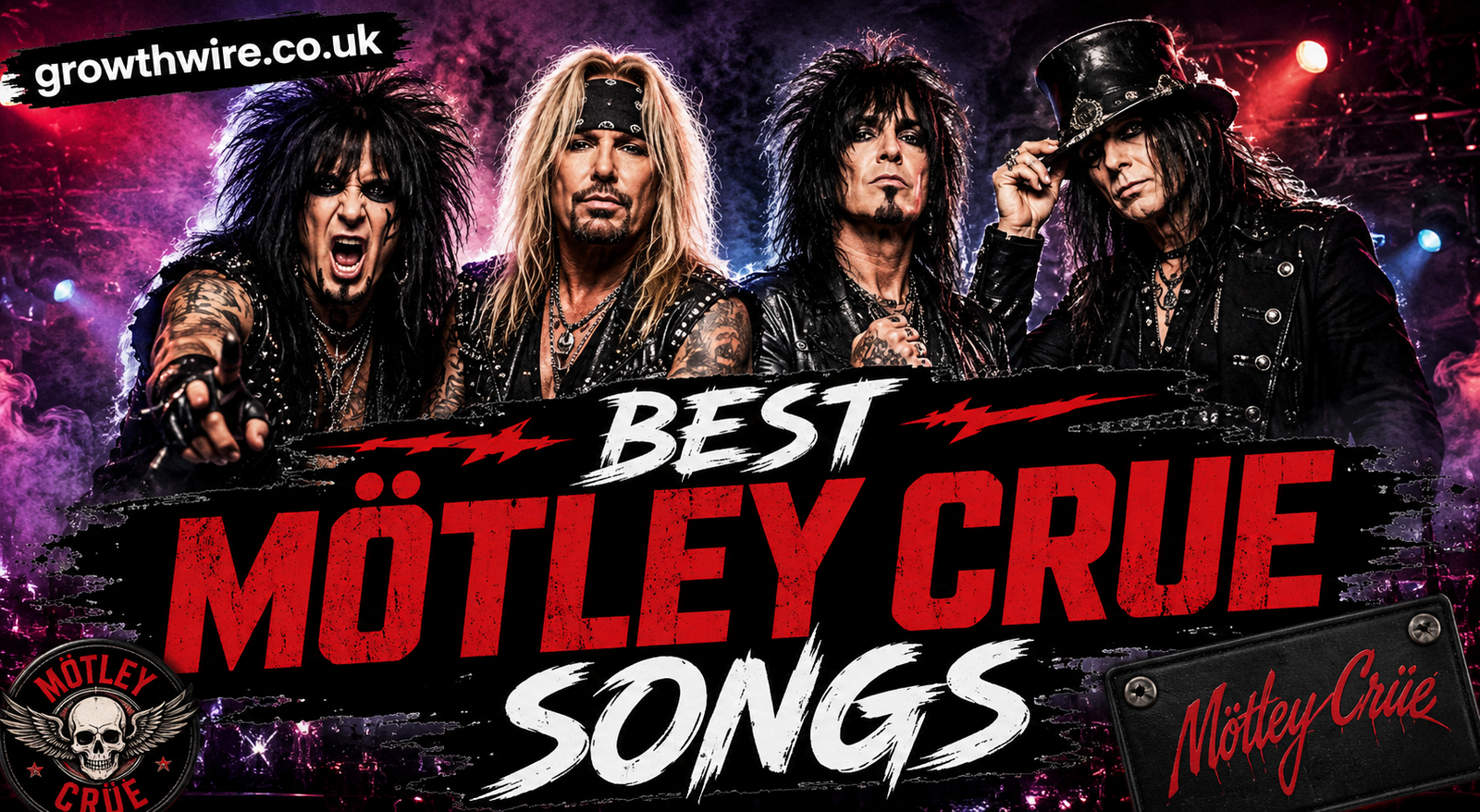
Few bands represent the excess, attitude, danger, and theatrical spirit of 1980s hard rock quite like Mötley Crüe. From their early days on the Sunset Strip to their rise as one of the biggest names in heavy metal and glam rock, the band built a catalog filled with unforgettable guitar riffs, huge choruses, rebellious lyrics, and songs that still sound powerful decades later.
Choosing the best Motley Crue songs is not easy. The group has released several studio albums across a career spanning more than four decades, and its music covers everything from raw early punk-influenced metal to polished arena-rock anthems and darker, more experimental material. Some tracks became massive radio hits, while others developed cult followings among longtime fans.
Mötley Crüe’s classic lineup featured vocalist Vince Neil, bassist Nikki Sixx, guitarist Mick Mars, and drummer Tommy Lee. Together, they created a distinctive sound that combined heavy guitars with catchy songwriting and a larger-than-life image. Their music became closely associated with the glam-metal movement, but the band’s strongest songs often had more substance than their outrageous reputation suggested.
Whether you are discovering the band for the first time or revisiting their classic records, this guide explores some of the most important and memorable songs in their catalog.
Why the Best Motley Crue Songs Still Matter
Mötley Crüe’s music has survived changing musical trends because the band’s strongest songs are built around simple but effective ingredients: memorable riffs, energetic performances, dramatic vocals, and choruses that are easy to remember.
The band emerged during a period when Los Angeles was becoming a major center for hard rock. Clubs on the Sunset Strip helped create an environment where ambitious young musicians could develop their sound and image. Mötley Crüe quickly stood out because they combined aggressive music with a theatrical presentation.
Their songs also capture different sides of rock culture. Some celebrate nightlife and rebellion, while others explore loneliness, addiction, heartbreak, mortality, and personal struggle. That contrast gives their catalog surprising depth.
A great Mötley Crüe song does not necessarily have to be the band’s biggest commercial hit. Some fan favorites demonstrate the group’s musical personality just as strongly as their most famous singles.
1. “Kickstart My Heart”
“Kickstart My Heart” is one of the band’s defining songs and an obvious candidate for any discussion of the best Motley Crue songs.
Released on the 1989 album Dr. Feelgood, the track immediately grabs attention with its rapid guitar riff, explosive drums, and relentless momentum. The song feels almost impossible to sit still through.
Its appeal comes partly from its energy. The rhythm section pushes the track forward while Mick Mars delivers a sharp, aggressive guitar performance. Vince Neil’s vocals add to the sense of urgency, giving the song the character of a high-speed rock anthem.
The lyrics are associated with Nikki Sixx’s well-known near-fatal overdose in 1987, adding a darker story beneath the song’s celebratory surface.
“Kickstart My Heart” eventually became one of Mötley Crüe’s most recognizable concert songs. Its massive chorus and explosive arrangement make it particularly effective in a live setting.
2. “Dr. Feelgood”
The title track from Dr. Feelgood is another essential entry.
Unlike some of the band’s earlier material, “Dr. Feelgood” demonstrates a more refined studio sound. The production is powerful without completely removing the roughness that made Mötley Crüe distinctive.
The song centers on a memorable guitar riff and a groove that gives the track an almost swaggering quality. Rather than simply racing forward, it allows the musicians to create tension and attitude.
The title refers to a drug dealer, continuing the band’s long-running fascination with the darker side of rock-and-roll culture.
“Dr. Feelgood” also represents an important moment in the band’s career. By 1989, Mötley Crüe had developed from a notorious club band into an arena-level act capable of producing polished commercial hard rock without losing its identity.
3. “Girls, Girls, Girls”
“Girls, Girls, Girls” became one of the band’s signature songs.
The track is built around a straightforward hard-rock riff, driving drums, and a chorus designed for audience participation. Its subject matter reflects the band’s notorious lifestyle during the 1980s, particularly the nightlife and excess surrounding the Los Angeles rock scene.
Musically, however, the song is remarkably efficient. It does not require complicated arrangements to make an impact. The guitar riff establishes the atmosphere almost immediately, while the rhythm section maintains a steady groove.
The song’s simplicity is part of its strength. It is instantly recognizable and remains one of the tracks most closely associated with the band’s public image.
4. “Home Sweet Home”
For a completely different side of Mötley Crüe, “Home Sweet Home” is essential.
Released on the 1985 album Theatre of Pain, the song showed that the band could move beyond aggressive hard rock and deliver an emotional power ballad.
Tommy Lee’s piano introduction creates a reflective mood before the full band enters. The lyrics focus on the loneliness and isolation that can come with life on the road.
That emotional perspective helped the song stand apart from many glam-metal ballads of its era. It is not simply a romantic love song. Instead, it expresses homesickness and the complicated relationship between a musician and the lifestyle that comes with fame.
“Home Sweet Home” eventually became one of the band’s most enduring songs and has been revisited in different versions over the years.
5. “Looks That Kill”
“Looks That Kill” comes from Shout at the Devil, the 1983 album that helped establish Mötley Crüe as a major force in American hard rock.
The song demonstrates the band’s early style particularly well. Mick Mars’s guitar work is heavy but melodic, while the rhythm section provides a forceful foundation.
Vince Neil’s performance gives the track a swaggering quality, and the chorus is immediately memorable.
The music video also helped strengthen the band’s theatrical image. At a time when MTV was becoming increasingly important to rock musicians, Mötley Crüe understood how visuals could help transform songs into cultural moments.
6. “Shout at the Devil”
The title track of Shout at the Devil is heavier and darker than many of the band’s later commercial hits.
The song’s dramatic atmosphere reflects the band’s early interest in sinister imagery and heavy-metal theatrics. It helped distinguish Mötley Crüe from more conventional rock acts of the period.
The production may sound different from modern metal, but that is part of its historical charm. The rawness of the recording captures the atmosphere of early-1980s heavy rock.
For listeners interested in the band’s origins, “Shout at the Devil” is an important starting point.
7. “Wild Side”
“Wild Side” is one of the strongest examples of the band’s ability to combine groove with heavy rock.
Released on Girls, Girls, Girls, the song features an energetic arrangement and a particularly memorable bass presence. Nikki Sixx’s songwriting gives it a rebellious character, while Tommy Lee’s drumming adds considerable power.
The track feels slightly more sophisticated than a basic party anthem. Its arrangement includes several musical shifts that keep it interesting without sacrificing accessibility.
It is also a strong representation of the band’s mid-1980s identity, when Mötley Crüe had become one of the most recognizable acts in rock.
8. “Too Young to Fall in Love”
“Too Young to Fall in Love” demonstrates the melodic side of Shout at the Devil.
The song has a darker mood than some of the band’s more playful tracks, with a strong guitar-driven arrangement and an instantly recognizable chorus.
Its appeal lies in the balance between melody and aggression. The song is heavy enough for metal fans but accessible enough for mainstream rock audiences.
That balance became one of the band’s greatest strengths throughout the 1980s.
9. “Smokin’ in the Boys Room”
Mötley Crüe’s version of “Smokin’ in the Boys Room” gave the band one of its biggest early mainstream hits.
Originally recorded by Brownsville Station, the song was transformed into a Mötley Crüe-style hard-rock anthem.
The track is playful, rebellious, and built around a chorus that is difficult to forget. It also helped broaden the band’s audience by introducing their sound to listeners who might not have discovered their heavier material.
Its success demonstrated that Mötley Crüe could take an existing rock song and make it feel like part of their own catalog.
10. “Same Ol’ Situation (S.O.S.)”
“Same Ol’ Situation (S.O.S.)” comes from Dr. Feelgood and showcases the band’s more polished late-1980s sound.
The track has a catchy rhythm and a highly accessible chorus. It is lighter than some of the band’s heavier material but still carries their distinctive attitude.
One reason the song remains memorable is its combination of straightforward songwriting and energetic instrumentation.
It also illustrates how the band had matured as songwriters by the end of the decade.
11. “Primal Scream”
“Primal Scream” arrived during a period when Mötley Crüe were changing direction.
Featured on Decade of Decadence 81–91, the song contains many of the elements associated with the group’s classic sound but feels slightly more aggressive and modern.
The guitars are prominent, the drums hit hard, and the overall arrangement has an almost confrontational quality.
For listeners exploring the band’s transition from the 1980s into the 1990s, “Primal Scream” is worth hearing.
12. “Don’t Go Away Mad (Just Go Away)”
This track from Dr. Feelgood shows another side of the band’s songwriting.
Instead of relying entirely on aggression, the song combines melody with emotional tension. The lyrics explore the end of a relationship, while the instrumentation maintains the band’s familiar hard-rock identity.
It is a good example of how Mötley Crüe could write accessible songs without becoming completely predictable.
The chorus is especially effective, making the track a favorite for listeners who prefer the band’s melodic material.
13. “On With the Show”
“On With the Show” comes from the band’s debut album, Too Fast for Love.
The track provides an interesting glimpse into Mötley Crüe before their sound became heavily associated with major-label production and arena-rock polish.
There is a rawness to the recording that captures the energy of the early Los Angeles club scene.
For longtime fans, songs like this are valuable because they reveal where the band’s musical journey began.
14. “Live Wire”
“Live Wire” is one of the most important songs from Too Fast for Love.
The track has an aggressive guitar riff, fast-moving rhythm, and an unmistakable early-Mötley Crüe attitude.
It also demonstrates the band’s ability to create songs that feel dangerous and energetic without requiring overly complicated musical structures.
“Live Wire” became a key part of the group’s early identity and remains a strong recommendation for anyone exploring their debut album.
15. “Red Hot”
“Red Hot” is another early highlight.
The song captures the raw energy that characterized Mötley Crüe before their sound became more polished. Its riff-driven approach and hard-hitting drums make it an excellent representation of the band’s early style.
For listeners who want to understand why the group attracted so much attention on the Sunset Strip, this is one of the tracks worth hearing.
16. “Without You”
“Without You” provides another look at Mötley Crüe’s ability to write emotional rock songs.
The track is slower and more melodic than many of the band’s aggressive numbers. Its arrangement creates space for the vocals and lyrics to take center stage.
Songs like this helped establish Mötley Crüe as more than a party band. They demonstrated that the musicians could also create material capable of connecting with listeners emotionally.
17. “You’re All I Need”
“You’re All I Need” is one of the band’s darker ballads.
Released on Girls, Girls, Girls, the song has a much more serious and unsettling tone than its title might suggest. The lyrics explore obsession and violence, giving the track an intentionally disturbing character.
Its controversial subject matter makes it different from the band’s more conventional love songs.
Musically, however, it is memorable because of its restrained arrangement and dramatic delivery.
18. “If I Die Tomorrow”
“If I Die Tomorrow” represents a later chapter in Mötley Crüe’s career.
Released in 2005 on Red, White & Crüe, the song has a more reflective tone than many of the band’s classic 1980s tracks.
Its lyrics encourage listeners to think about mortality, relationships, and the limited nature of time.
The song demonstrates that Mötley Crüe could still write emotionally resonant material long after their commercial peak.
19. “Saints of Los Angeles”
“Saints of Los Angeles” became the title track of the band’s 2008 studio album.
The song looks back at the group’s history and the world that produced them. It carries the familiar Mötley Crüe combination of loud guitars, strong drums, and rebellious lyrics while acknowledging the band’s decades-long journey.
For fans interested in the band’s later work, it is one of the most important songs to explore.
20. “Too Fast for Love”
The title track from the band’s debut album perfectly summarizes the attitude of their early career.
“Too Fast for Love” is energetic, rough around the edges, and unapologetically rock-oriented. It feels like a product of the early-1980s club scene rather than a carefully manufactured mainstream release.
That authenticity is precisely why the song remains important.
It also provides a useful reminder that Mötley Crüe’s success did not happen overnight. The band’s identity developed through years of playing small venues and building a loyal audience.
How to Choose the Best Motley Crue Songs for a Playlist
There is no single correct Mötley Crüe playlist because different songs appeal to different listeners.
If you want high-energy rock, start with “Kickstart My Heart,” “Wild Side,” “Live Wire,” and “Primal Scream.”
For classic glam-metal atmosphere, try “Girls, Girls, Girls,” “Looks That Kill,” “Too Young to Fall in Love,” and “Shout at the Devil.”
If you prefer emotional songs, “Home Sweet Home,” “Without You,” and “Don’t Go Away Mad” are excellent choices.
For a look at the band’s early sound, begin with Too Fast for Love and explore “Live Wire,” “On With the Show,” and “Too Fast for Love.”
For a more polished arena-rock experience, Dr. Feelgood is an excellent place to start.
The Importance of Dr. Feelgood
When discussing the band’s strongest albums, Dr. Feelgood deserves special attention.
Released in 1989, the record represented the culmination of Mötley Crüe’s 1980s development. The album combined the band’s trademark attitude with significantly improved production and songwriting.
Its title track, “Kickstart My Heart,” “Don’t Go Away Mad,” and “Same Ol’ Situation” demonstrate different sides of the band’s abilities.
The album also benefited from strong production, allowing the guitars, drums, bass, and vocals to sound bigger than on the group’s earliest recordings.
For someone unfamiliar with Mötley Crüe, Dr. Feelgood is arguably one of the easiest albums through which to understand the band’s appeal.
Why “Home Sweet Home” Remains So Important
While songs like “Kickstart My Heart” represent the band’s explosive side, “Home Sweet Home” demonstrates why emotional material was equally important to their legacy.
The song became closely associated with musicianship, touring, and the complicated emotions surrounding life on the road.
Its piano-led opening immediately creates a different atmosphere from the band’s heavier songs. The arrangement gradually expands, giving the chorus an emotional payoff.
The song also influenced the role of power ballads within the glam-metal genre. It showed that a band known for loud guitars and outrageous performances could also produce music that felt vulnerable.
The Role of Mick Mars
Mick Mars was an essential part of Mötley Crüe’s musical identity.
His guitar style was generally less flashy than that of some other glam-metal guitarists. Instead, Mars focused on riffs, texture, groove, and memorable melodies.
That approach helped the band’s songs remain recognizable.
Tracks such as “Looks That Kill,” “Dr. Feelgood,” “Wild Side,” and “Kickstart My Heart” demonstrate how important his guitar work was to the group’s sound.
His playing often supported the song rather than dominating it, which helped Mötley Crüe maintain a strong balance between musicianship and accessibility.
Nikki Sixx and the Songwriting Identity
Nikki Sixx played a major role in developing Mötley Crüe’s songwriting identity.
His lyrics frequently explored rebellion, nightlife, danger, relationships, addiction, and personal struggle. These subjects reflected the band’s public image but also allowed the music to tell stories about the darker side of rock culture.
Sixx’s songwriting is particularly effective when the lyrics are paired with simple, memorable riffs.
That combination helped Mötley Crüe create songs that could be immediately understood while still carrying a distinctive personality.
Tommy Lee’s Contribution
Tommy Lee’s drumming is another defining element of the band’s sound.
His playing could be powerful and straightforward when the song demanded it, but he was also known for incorporating theatrical elements into live performances.
On recordings, his drums provide much of the band’s momentum. Tracks such as “Kickstart My Heart” depend heavily on the energy of the rhythm section.
His ability to combine technical skill with showmanship helped make him one of the most recognizable drummers associated with glam metal.
Vince Neil and the Mötley Crüe Sound
Vince Neil’s voice is immediately recognizable.
His high, distinctive vocal style helped establish the band’s identity during the 1980s. Rather than sounding like a traditional blues-rock vocalist, Neil brought a youthful and energetic quality to the music.
That vocal approach worked particularly well on songs built around large choruses.
Whether delivering the aggressive material or more melodic songs, his voice remains an important reason Mötley Crüe recordings are so easily identified.
What Makes These Songs Timeless?
The strongest Mötley Crüe songs share several characteristics.
First, they are memorable. A great riff or chorus can remain in a listener’s head after only one hearing.
Second, they have personality. Mötley Crüe rarely sounded anonymous. Even when working within familiar hard-rock formulas, the band brought a recognizable attitude to the music.
Third, many songs have strong live potential. Tracks such as “Kickstart My Heart” and “Girls, Girls, Girls” are designed to create a reaction from a crowd.
Finally, the band’s best material captures a specific cultural moment while remaining enjoyable outside that era.
Final Thoughts on the Best Motley Crue Songs
The best Motley Crue songs represent much more than a collection of loud guitar tracks. Together, they tell the story of a band that rose from the Los Angeles club scene to international rock stardom.
“Kickstart My Heart” delivers pure adrenaline. “Home Sweet Home” reveals a more emotional side. “Dr. Feelgood” represents the band’s polished commercial peak, while “Live Wire” and “Too Fast for Love” preserve the raw energy of their beginnings.
Other songs, including “Looks That Kill,” “Wild Side,” “Shout at the Devil,” “Girls, Girls, Girls,” and “Don’t Go Away Mad,” demonstrate the range within the band’s classic catalog.
The most important thing is that there is no definitive ranking that every listener will agree on. Music is subjective, and Mötley Crüe’s catalog is broad enough to support different interpretations.
For newcomers, the best approach is to listen across several albums rather than relying only on the biggest singles. Start with Too Fast for Love, move through Shout at the Devil and Theatre of Pain, then explore Girls, Girls, Girls and Dr. Feelgood. From there, later material provides a wider view of the band’s evolution.
After decades of changing musical fashions, Mötley Crüe’s most memorable songs continue to deliver the same qualities that made the band famous in the first place: attitude, volume, melody, rebellion, and an unmistakable sense of rock-and-roll spectacle.
