


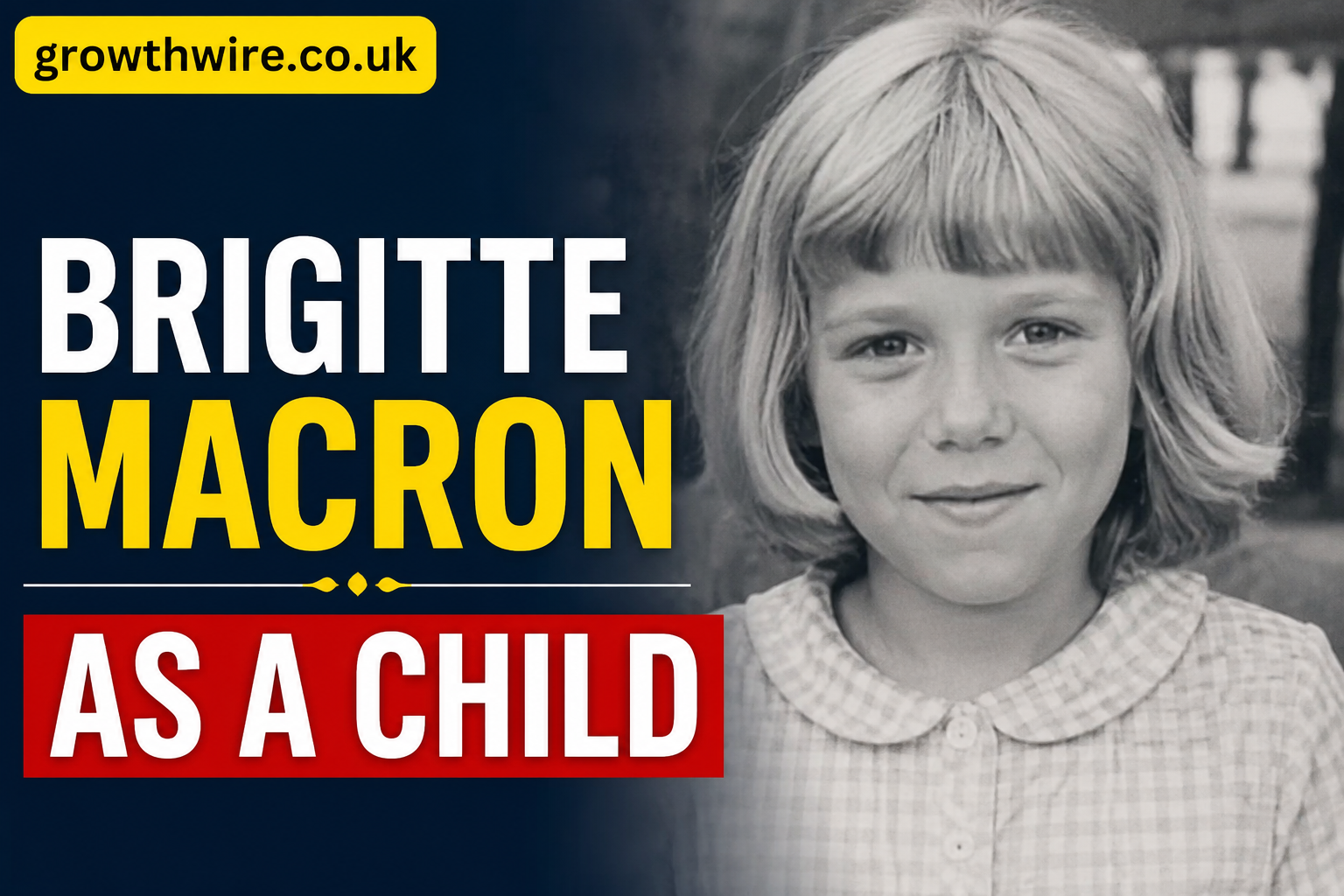
Brigitte Macron as a Child in Amiens
Brigitte Macron as a child grew up in Amiens, a city in northern France that would shape much of her early identity and later public image. She was born Brigitte Marie-Claude Trogneux on 13 April 1953, and the French presidency’s official biography confirms that Amiens is her birthplace. Her background is closely tied to a well-known local family business, which gives her childhood story a distinctly regional and family-centered character rather than the detached, purely political biography often attached to public figures.
Her childhood is often discussed because it helps explain how someone from a prosperous but traditional French family later became one of the most visible women in Europe. In Brigitte Macron’s case, the “as a child” lens matters because it reveals the starting point: a girl raised in a specific social, cultural, and religious environment long before she became the spouse of a president. That early world was shaped by family expectations, Catholic education, and the rhythms of life in Amiens.
Family Background and the Trogneux Household
Brigitte Macron as a child was the youngest of six children in the Trogneux family, a family associated with chocolate making in Amiens for generations. Reuters describes her as the youngest child in a wealthy family of chocolate makers, and other reputable biographical sources agree that the family’s business heritage was an important part of her background. This detail matters because it shows that her early life was not shaped by hardship or instability, but by a stable and established household with strong local roots.
The Trogneux name is well known in Amiens, and the family business is part of the town’s identity. That means Brigitte grew up in an atmosphere where civic reputation, enterprise, and family continuity were likely very present. For a child, that kind of environment can create both privilege and pressure: privilege because resources and social standing are available, and pressure because family names often carry expectations that extend beyond the home. Even when an adult later enters public life, the tone of that early setting can remain visible.
A childhood in a large family can also shape personality in subtle ways. Being the youngest of six often means learning to observe, negotiate, and adapt within a crowded household. While no source can fully reconstruct the emotional texture of Brigitte Macron’s childhood, the family structure itself suggests a home where relationships, conversation, and daily interaction were central. In later life, she became known for confidence, communication, and a strong personal presence; those traits may well have roots in such an environment. That is an interpretation, but it is one consistent with the family picture confirmed by the historical record.
A Catholic Education and Early Discipline
Brigitte Macron as a child was raised in a Catholic household, and she attended the Lycée du Sacré-Cœur, a private Catholic school in Amiens. This is one of the clearest clues to the values surrounding her upbringing. A Catholic education in mid-20th-century France usually meant discipline, structure, and a strong emphasis on manners, conduct, and achievement. It also placed her within a social world where tradition and education were closely linked.
That school setting likely mattered a great deal in shaping her worldview. Private Catholic schooling in France often carried both academic and moral expectations, and Brigitte’s later life suggests that she absorbed that environment deeply. She would go on to become a teacher herself, which may not be surprising in light of a childhood spent in classrooms that valued order, language, and intellectual seriousness. Her career path looks, in many ways, like a continuation of the educational culture she encountered early on.
Some reports suggest she was a strong student, and one French source even describes her as a good pupil who could also be a bit rebellious or distracted at times. That portrait feels human rather than mythic: a child who learned well, but who was not necessarily quiet or perfectly conforming. It is often in those small contradictions that a future public figure begins to emerge. The exact details of her childhood temperament are harder to verify than the broad facts of her schooling, but the pattern is consistent with later descriptions of her being energetic, expressive, and self-possessed.
Brigitte Macron as a Child and the World of Amiens
Brigitte Macron as a child was shaped by Amiens itself. The city is not only her birthplace; it is also the place where her family’s reputation, school life, and later teaching career all intersected. That continuity matters. Many public figures are defined by movement and reinvention, but her early life appears to have been anchored in one place. The result is a biography that feels rooted, local, and unusually coherent.
Amiens is a city with a strong sense of heritage, and growing up there would have meant being surrounded by both tradition and civic identity. For a child from a prominent local family, the city itself may have functioned almost like an extended social circle: familiar streets, recognizable institutions, and a network of families who knew one another. That sort of setting can encourage stability, but it can also create visibility very early in life. A child learns not only who she is, but also how she is seen.
This local foundation matters when we think about her later public role. Brigitte Macron eventually became First Lady of France, a position that places personal image under constant attention. Yet the seeds of that public life were planted in a much quieter world, where identity was built around family name, education, and neighborhood reputation. The contrast between those two stages—childhood in Amiens and adult life at the Élysée—is one reason people remain fascinated by her early years.
Childhood, Family Identity, and the Power of Tradition
One reason people search for “Brigitte Macron as a child” is that childhood often helps explain public identity in a way adult headlines cannot. In her case, the family background is especially meaningful because the Trogneux name carries local history and business prestige. That means her childhood was not formed in an anonymous setting. She belonged to a family that was recognized, established, and connected to a recognizable craft.
Children raised in such households often absorb a sense of continuity. Family stories, professional expectations, and social obligations can all become part of the background of daily life. Even if a child does not consciously think in those terms, the structure can leave a mark. Later in life, Brigitte Macron would show a strong sense of composure and an ability to move with confidence in highly visible settings. It is reasonable to see her upbringing as one source of that ease. That is not a claim of direct causation, but an informed reading of the life pattern that emerged from her early environment.
There is also a symbolic dimension to her childhood. The public often sees her as a modern political spouse, yet the child in Amiens belonged to another France: more traditional, more locally rooted, and more closely tied to family businesses and Catholic schooling. That older France did not disappear from her life; it became one layer of a broader identity that would later be seen on the national stage.
How Brigitte Macron as a Child Helped Shape Her Future Career
Brigitte Macron as a child likely developed a close relationship with language, discipline, and performance long before she became a teacher. Her later professional life in education suggests comfort with structured learning and with guiding others. She went on to teach literature and French, and she spent years in schools before stepping back to support Emmanuel Macron’s political rise. The path from a Catholic schoolgirl in Amiens to a respected educator and national figure feels coherent because the early and later chapters are linked by a sustained engagement with culture and learning.
That career choice is not random. Children who grow up in families that value education often internalize the idea that knowledge is a form of discipline and service. In Brigitte’s case, the transition from student to teacher seems especially natural. The classroom allowed her to occupy a role that combined authority, communication, and care—qualities that are often nurtured early in life. While we should be careful not to overstate what childhood alone explains, the pattern between her upbringing and profession is striking.
Her later meeting with Emmanuel Macron at Lycée La Providence in Amiens also reflects how deeply her life remained connected to her hometown and its institutions. According to the Élysée and Reuters, she met him through a theater workshop she was running at the school, where she was already established as an educator. That later chapter became famous for personal and political reasons, but it also highlights something important about her early story: the same city that shaped her childhood also provided the setting for her adult career.
Why People Still Care About Brigitte Macron as a Child
The continuing interest in Brigitte Macron as a child says as much about public curiosity as it does about her own life. People want to know how a future First Lady was formed, especially when the adult version is so visible, so discussed, and so often interpreted through politics, fashion, and family life. Childhood stories help make public figures feel understandable. They suggest origin, continuity, and explanation.
In Brigitte’s case, the interest is sharpened by contrast. Her adult life has included teaching, marriage, political prominence, and intense media scrutiny. Her childhood, by comparison, feels private and almost conventional: a girl in Amiens, part of a large family, educated in a Catholic school, growing up in a town with a strong local identity. That contrast creates narrative power. The public sees a polished and highly visible woman, and then looks backward to ask how that person came to be.
There is also a broader cultural reason. First ladies and presidential spouses often become the subject of retrospective biography because they occupy a public role without having been elected to it. That makes their personal histories feel especially revealing. In Brigitte Macron’s case, her childhood is interesting not because it is dramatic in itself, but because it shows how an apparently ordinary early life can lead to an extraordinary public role.
A Childhood That Still Echoes in Public Life
Brigitte Macron as a child was not being groomed for the Élysée Palace, and that is exactly what makes her early story compelling. She came from a respected family in Amiens, received a Catholic education, and grew up in an environment shaped by tradition and local identity. Those foundations did not predict every later turn in her life, but they helped form the habits and values that would matter later: poise, discipline, and confidence in public settings.
Her childhood also reminds us that public figures are not born public. They become visible through a long sequence of family influences, educational experiences, and personal decisions. Brigitte Macron’s early years were ordinary in the best sense of the word: family-centered, rooted in place, and shaped by institutions that valued learning. From that ordinary beginning came an unusual public life, one that has made her one of the most discussed women in France.
Seen this way, Brigitte Macron’s childhood is more than a biographical footnote. It is the first chapter of a larger story about identity, memory, and public presence. The young girl in Amiens could not have known what the future held, but the values surrounding her—family, education, religion, and local continuity—would remain visible across the decades. That is why “Brigitte Macron as a child” remains such an enduring point of curiosity: it offers a human beginning to a very public life.
Conclusion
Brigitte Macron as a child was shaped by a stable and recognizable world: a large family, a respected local business background, Catholic schooling, and the civic life of Amiens. Those early conditions did not make her future inevitable, but they did give structure to the person she became. When people ask about her childhood, they are really asking how a private beginning can lead to a public destiny. In Brigitte Macron’s case, the answer lies in a life that stayed connected to education, place, and personal discipline from the start.
