


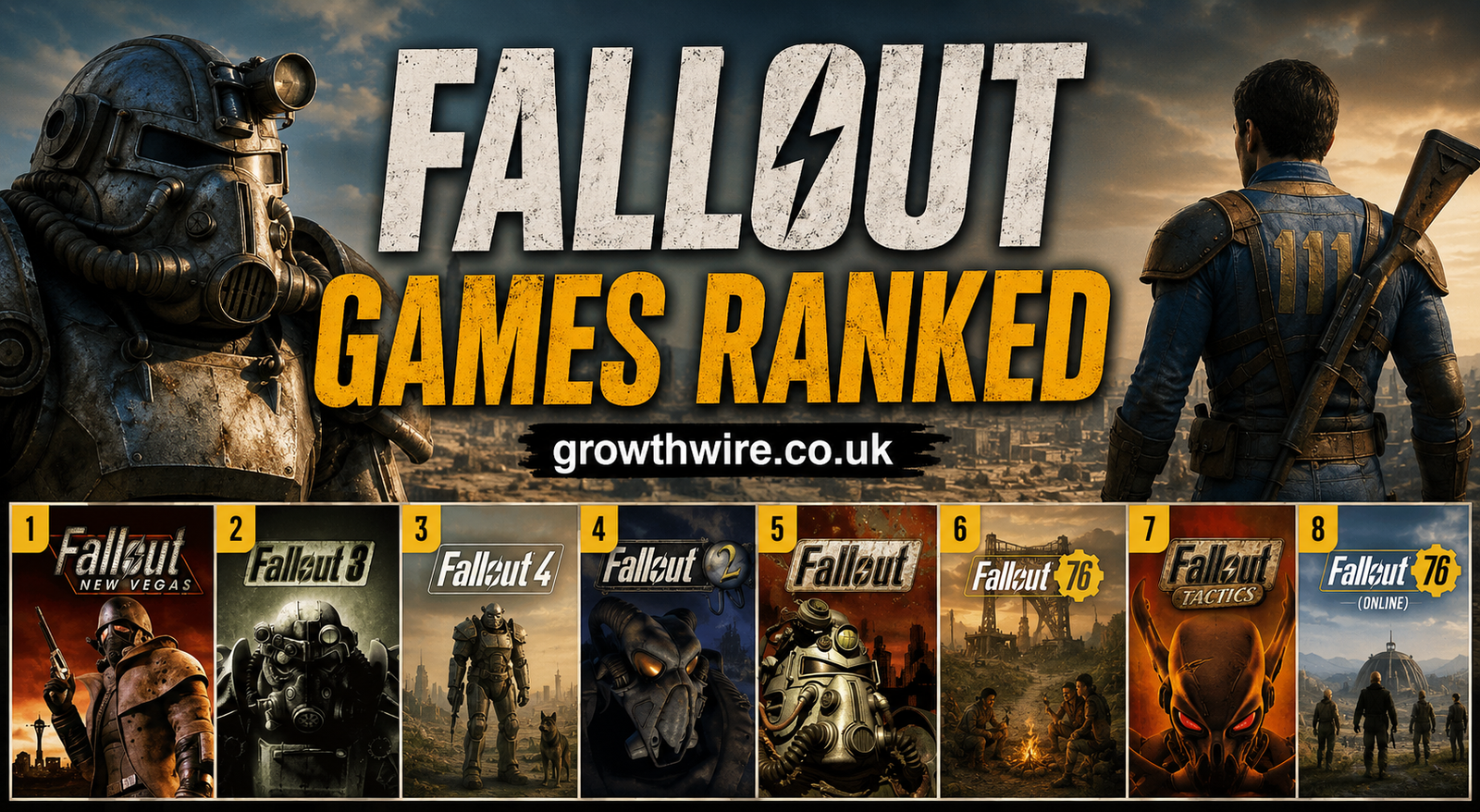
The Fallout games ranked conversation is one of those debates that never seems to end. The series has changed developers, engines, gameplay systems, and even its overall tone several times, yet each major entry has built a dedicated audience. Some players prefer the deep role-playing mechanics of the classic games, while others enjoy the open-world exploration and first-person combat introduced in later releases.
What makes ranking the Fallout series especially difficult is that the games are not simply improved versions of one another. Each title has its own identity. One might offer a stronger story, another a better open world, while another delivers more satisfying character customization or memorable factions.
From the original isometric adventure to the enormous worlds of the modern era, the series has experimented with nearly every major role-playing formula. This ranking considers the main games based on story, world-building, role-playing depth, exploration, gameplay, atmosphere, replayability, and lasting influence.
Fallout Games Ranked: How the Series Is Judged
Before getting into individual positions, it is important to establish what makes a Fallout game stand out.
A great entry needs more than a large map or impressive combat. Fallout has always been about choice and consequence. The best games give players opportunities to approach problems in different ways and allow their character’s abilities, relationships, and decisions to influence the experience.
The ranking below considers several factors:
- Story and writing: How engaging and memorable is the main narrative?
- Role-playing: How much freedom does the player have to create a distinct character?
- World-building: Does the setting feel believable and interesting?
- Exploration: Are there meaningful discoveries away from the main quest?
- Gameplay: Are combat, progression, crafting, and other systems enjoyable?
- Characters and factions: Does the game offer memorable people and competing interests?
- Replayability: Does another playthrough feel substantially different?
- Legacy: How strongly did the game influence the franchise?
With those factors in mind, here is a ranking of the major Fallout games.
8. Fallout 76
When discussing Fallout games ranked, Fallout 76 is perhaps the hardest game to place because its history is so unusual.
The multiplayer-focused title launched in 2018 with a controversial reception. At release, many players criticized its lack of human NPCs, technical problems, limited quest structure, and numerous bugs. However, the game evolved considerably after launch.
Later updates introduced human characters, new storylines, additional factions, improved questing, and a much more populated Appalachia. The result is substantially different from the experience many players encountered at launch.
Fallout 76’s greatest strength is its setting. Appalachia offers forests, mountains, abandoned towns, industrial areas, underground facilities, and strange landmarks. It also has a distinctive atmosphere that separates it from the more familiar Washington and Mojave landscapes.
The multiplayer component can be entertaining, particularly for players who enjoy building settlements, collecting equipment, completing events, and exploring with friends.
However, the online structure can make the experience feel less focused than the strongest single-player entries. Character builds and progression are enjoyable, but the traditional Fallout role-playing experience is not always as strong.
For players seeking a cooperative Fallout experience, Fallout 76 has plenty to offer. For those primarily interested in the series’ greatest stories and deepest choices, other entries rank higher.
7. Fallout 4
Fallout 4 is one of the most commercially successful entries, and there is a good reason for that.
Its version of Boston and the surrounding Commonwealth is packed with locations to explore. Players can wander into abandoned factories, underground facilities, settlements, military installations, ruined neighborhoods, and countless strange side stories.
The shooting mechanics also represent a major improvement over earlier 3D entries. Weapons feel more responsive, aiming is smoother, and combat is easier to enjoy without relying entirely on traditional role-playing statistics.
Another major feature is settlement construction. Players can build and customize settlements, establish supply lines, gather resources, and create elaborate bases. For some players, this becomes one of the most addictive parts of the game.
Fallout 4 also introduced a more sophisticated crafting system. Weapons and armor can be modified extensively, allowing players to create equipment suited to their preferred playstyle.
The main weakness is its role-playing dialogue system. Compared with Fallout: New Vegas, the player’s ability to shape conversations and express a highly specific personality is more limited. The voiced protagonist also makes the player character feel somewhat more defined than in previous games.
Nevertheless, Fallout 4 remains an excellent open-world RPG. Its exploration, combat, crafting, companions, and environmental storytelling make it one of the most accessible games in the franchise.
6. Fallout
The original Fallout deserves enormous respect even if its age makes it less accessible to modern players.
Released in 1997, the game established many of the ideas that would become central to the franchise. It introduced the post-apocalyptic setting, SPECIAL character system, Vaults, retro-futuristic technology, factions, dark humor, moral decisions, and an approach to storytelling that trusted players to explore.
The original game is remarkably compact compared with modern open-world RPGs. Instead of presenting a gigantic landscape filled with hundreds of activities, it creates a concentrated world where decisions can have significant consequences.
Combat is turn-based and heavily influenced by character statistics, equipment, and tactical positioning. Players who enjoy classic RPG mechanics will find considerable depth here.
The writing is also a major strength. Fallout combines bleak post-apocalyptic themes with absurd humor and retro Americana. That combination became one of the defining characteristics of the franchise.
The biggest barrier is accessibility. The interface can feel unfamiliar, movement is slower, and the difficulty can be unforgiving. Players accustomed to modern first-person Fallout titles may need time to adjust.
Still, its influence is undeniable. Without the original Fallout, the franchise as we know it would not exist.
5. Fallout 2
Fallout 2 took the foundation of the original and expanded it considerably.
Released in 1998, it offered a larger world, more locations, more characters, more factions, and significantly more opportunities for unusual interactions. It also leaned heavily into the dark humor that would become a recognizable part of the series.
The game gives players tremendous freedom. Character builds matter, dialogue choices matter, equipment matters, and seemingly insignificant decisions can produce unexpected results.
One of Fallout 2’s biggest strengths is the sheer number of ways to approach problems. A highly intelligent character, a charismatic negotiator, a combat specialist, or a bizarrely specialized build can all experience the world differently.
The writing is often excellent, although some of its humor and references can feel dated. Its increased size can also make the game less focused than the original.
For fans of traditional computer role-playing games, however, Fallout 2 remains a landmark.
Its position in this ranking is not a reflection of quality. Instead, it reflects how approachable it is compared with later games. Players willing to embrace its old-school mechanics may find one of the richest RPG experiences in the series.
4. Fallout 3
Fallout 3 transformed the franchise.
When Bethesda Game Studios released the game in 2008, it brought Fallout into a fully 3D open world and introduced the series to a much larger audience. Players could leave Vault 101 and explore the Capital Wasteland almost immediately.
That sense of freedom was revolutionary for many players.
The Capital Wasteland is bleak, strange, and full of memorable locations. Players can follow the main story or simply wander in a random direction and discover something unexpected.
Fallout 3 also successfully translated many classic elements into a first-person environment. The SPECIAL system remained, dialogue choices remained, character perks remained, and the world continued to reward curiosity.
The atmosphere deserves particular praise. The ruined Washington, D.C., environment feels lonely and dangerous. Abandoned buildings, destroyed neighborhoods, underground tunnels, and strange settlements contribute to a strong sense of place.
The game is not perfect. Some mechanics have aged, gunplay is less polished than in Fallout 4, and the moral choices can occasionally feel overly simplistic.
Even so, Fallout 3 deserves its place among the franchise’s most important releases. It demonstrated that the series could successfully move from isometric classic RPGs to expansive 3D worlds.
3. Fallout: New Vegas
Fallout: New Vegas is one of the most frequently praised entries in the franchise, especially among players who prioritize role-playing and player choice.
Developed by Obsidian Entertainment and released in 2010, New Vegas takes place in the Mojave Wasteland. The player becomes the Courier, a mysterious traveler who survives an attempted assassination and becomes involved in a struggle for control of the region.
The central conflict between the New California Republic, Caesar’s Legion, Mr. House, and independent forces gives the game a fascinating political structure.
Rather than presenting simple heroes and villains, New Vegas often asks players to decide which flawed organization offers the least damaging future. Factions have understandable motivations, serious weaknesses, and conflicting priorities.
The game’s dialogue and quest design are among its greatest strengths. Speech, reputation, character skills, faction relationships, and previous decisions can influence how situations unfold.
The Mojave itself is also filled with memorable locations and side stories. Many quests can be approached in several ways, making different character builds genuinely meaningful.
New Vegas does have technical issues and a somewhat rougher presentation than Fallout 3 and Fallout 4. Its development timeline also meant that some ambitious ideas were left unfinished or underdeveloped.
But its role-playing depth is exceptional.
For players who believe Fallout should primarily be about meaningful choices, factions, consequences, and character freedom, New Vegas has a strong argument for the top position.
2. Fallout 3: Game of the Year Edition and the Complete Experience
Although Fallout 3 and its original release are technically the same core game, the complete version deserves special consideration because its expansions significantly improve the overall package.
The downloadable content adds new locations, quests, challenges, and stories. Some expansions experiment with different gameplay structures, while others expand the Capital Wasteland experience.
The broader package demonstrates one of Fallout 3’s greatest strengths: exploration.
The game constantly encourages players to investigate unusual buildings or follow mysterious signals. A location that appears insignificant on the map can contain an entire quest or story.
Its radio system also became iconic. Listening to music and broadcasts while traveling through a devastated Washington creates an atmosphere that is difficult to replicate.
The game’s success helped establish the modern Fallout formula: a huge open world, first-person exploration, traditional RPG statistics, weapons and armor, companions, side quests, factions, and environmental storytelling.
While New Vegas arguably offers deeper role-playing, Fallout 3 often delivers a stronger feeling of discovery.
That distinction makes the two games difficult to compare directly.
1. Fallout: New Vegas
Why Fallout: New Vegas Leads the Fallout Games Ranked List
At number one, Fallout: New Vegas earns the top spot because it best combines the franchise’s traditional role-playing philosophy with the freedom of a modern open-world game.
Its greatest achievement is that the player’s decisions genuinely feel important.
The Courier is not a predetermined hero with a fixed personality. Instead, players can decide what kind of person they want to become. They can cooperate with factions, betray them, manipulate them, ignore them, or attempt to create an independent future.
The faction system is particularly impressive.
The New California Republic represents an expanding government attempting to bring order to the wasteland. Caesar’s Legion offers an authoritarian alternative built around military discipline. Mr. House represents technological control and economic power. Independent options provide another path.
None of these choices is presented as completely perfect.
This ambiguity makes New Vegas feel like a genuine role-playing game rather than simply an action game with dialogue.
The Strength of Character Builds
Character development is another reason New Vegas ranks so highly.
Skills such as Speech, Science, Medicine, Lockpick, Repair, Survival, and others can affect the player’s options. Perks further specialize the character.
A player focused on dialogue can solve situations without fighting. A technically skilled character can access terminals or repair equipment. A combat-oriented character can rely on weapons and specialized perks.
This means character creation has practical consequences throughout the adventure.
The Mojave Wasteland
The Mojave is not necessarily the largest environment in the franchise, but it is one of the most purposeful.
Locations are connected through faction politics, character stories, resources, and history. Even relatively small settlements can have their own conflicts.
Places such as Goodsprings, Novac, Freeside, and the New Vegas Strip each have distinct personalities.
The landscape also communicates the world without requiring constant exposition. Ruins, abandoned facilities, military installations, and settlements reveal what happened before the Courier arrived.
Side Quests That Matter
One of New Vegas’s greatest accomplishments is its side content.
Many side quests do not feel like filler. They introduce factions, reveal character motivations, explore the consequences of previous events, or force the player to make difficult decisions.
This creates a world where exploring outside the main story is often just as rewarding as following the central narrative.
Why New Vegas Still Holds Up
Even years after release, New Vegas remains popular because its design philosophy is difficult to replace.
Modern games may offer larger maps, more sophisticated graphics, smoother shooting, and more advanced technology. But New Vegas demonstrates that meaningful choice can matter more than scale.
Its technical limitations are obvious, but its underlying role-playing design remains powerful.
That is why it takes the top spot in this Fallout games ranked list.
What Makes the Fallout Series Special?
The rankings can change depending on what a player values most.
Someone who prioritizes exploration might rank Fallout 4 first. A player who loves classic RPGs may prefer Fallout 2. Someone looking for atmosphere could choose Fallout 3, while a multiplayer fan may place Fallout 76 much higher.
That flexibility is one of the franchise’s greatest strengths.
Fallout has never been locked into one style of gameplay. It has successfully moved from turn-based isometric RPGs to first-person open-world adventures and then into multiplayer survival territory.
The constant element is the world itself: a strange mixture of nuclear devastation, retro-futuristic technology, dark comedy, political conflict, and human survival.
Fallout Games Ranked by Category
A single ranking cannot capture every strength, so it can be useful to look at the series from different perspectives.
Best Story
Fallout: New Vegas is the strongest choice for players who want complex faction politics and meaningful narrative decisions.
Best Exploration
Fallout 4 is arguably the winner here. The Commonwealth is enormous and filled with locations, environmental stories, crafting materials, hidden areas, and random encounters.
Best Classic RPG
Fallout 2 stands out because of its character freedom, dialogue systems, and enormous range of possible approaches.
Best Introduction to the Modern Series
Fallout 3 remains an excellent starting point for someone who wants to understand how the classic formula evolved into the modern open-world format.
Best Combat
Fallout 4 offers the smoothest shooting and weapon customization among the major single-player entries.
Best Multiplayer Experience
Fallout 76 is the obvious choice because it was designed around shared exploration, online events, base building, and cooperative play.
Best Role-Playing
Fallout: New Vegas remains difficult to beat because skills, factions, dialogue, reputation, and decisions all interact.
The Evolution of Fallout
Looking at the Fallout games ranked from a historical perspective reveals how dramatically the series has evolved.
The first two games established the franchise as a traditional computer RPG. They emphasized statistics, dialogue, tactical combat, and freedom.
Fallout 3 changed the formula by moving the series into a first-person 3D open world. It introduced the franchise to millions of players who may never have experienced the originals.
New Vegas then combined that modern framework with a stronger emphasis on player choice and faction-based storytelling.
Fallout 4 pushed further toward action, crafting, settlement building, and accessible exploration.
Fallout 76 expanded the formula into an online world where players could experience the wasteland together.
Each transition created controversy, but each also expanded what Fallout could be.
Which Fallout Game Should You Play First?
If you are new to the franchise, the best starting point depends on your preferences.
Choose Fallout 4 if you want modern graphics, smoother combat, crafting, and an enormous world to explore.
Choose Fallout 3 if you want a darker atmosphere and a straightforward introduction to the modern Fallout formula.
Choose Fallout: New Vegas if you care most about dialogue, factions, role-playing, and meaningful choices.
Choose Fallout 2 or the original Fallout if you enjoy classic RPG mechanics and don’t mind older interfaces.
Choose Fallout 76 if you want an online experience that you can enjoy with other players.
There is no universally correct entry point. The important thing is choosing the game that matches the kind of experience you enjoy.
Final Thoughts on Fallout Games Ranked
Ranking the Fallout games ranked is ultimately subjective, but the series’ strongest entries share one important quality: they make the wasteland worth exploring.
The original Fallout established the foundation. Fallout 2 expanded the classic role-playing formula. Fallout 3 successfully transformed the franchise into a 3D open-world RPG. New Vegas demonstrated how powerful player choice and faction politics could be. Fallout 4 refined exploration, combat, crafting, and settlement building, while Fallout 76 showed that the wasteland could work as a shared online environment.
For this ranking, Fallout: New Vegas takes first place because it provides the strongest balance of role-playing freedom, storytelling, factions, character development, and consequences.
But the beauty of Fallout is that another player’s list can look completely different.
If you value exploration, Fallout 4 may be your favorite. If atmosphere matters most, Fallout 3 might win. If classic RPG depth is what you want, Fallout 2 could easily take the crown.
Ultimately, there is no single way to experience the wasteland. Every game offers its own interpretation of a world struggling to survive after nuclear devastation—and that variety is precisely why the Fallout franchise remains one of gaming’s most enduring role-playing series.
