


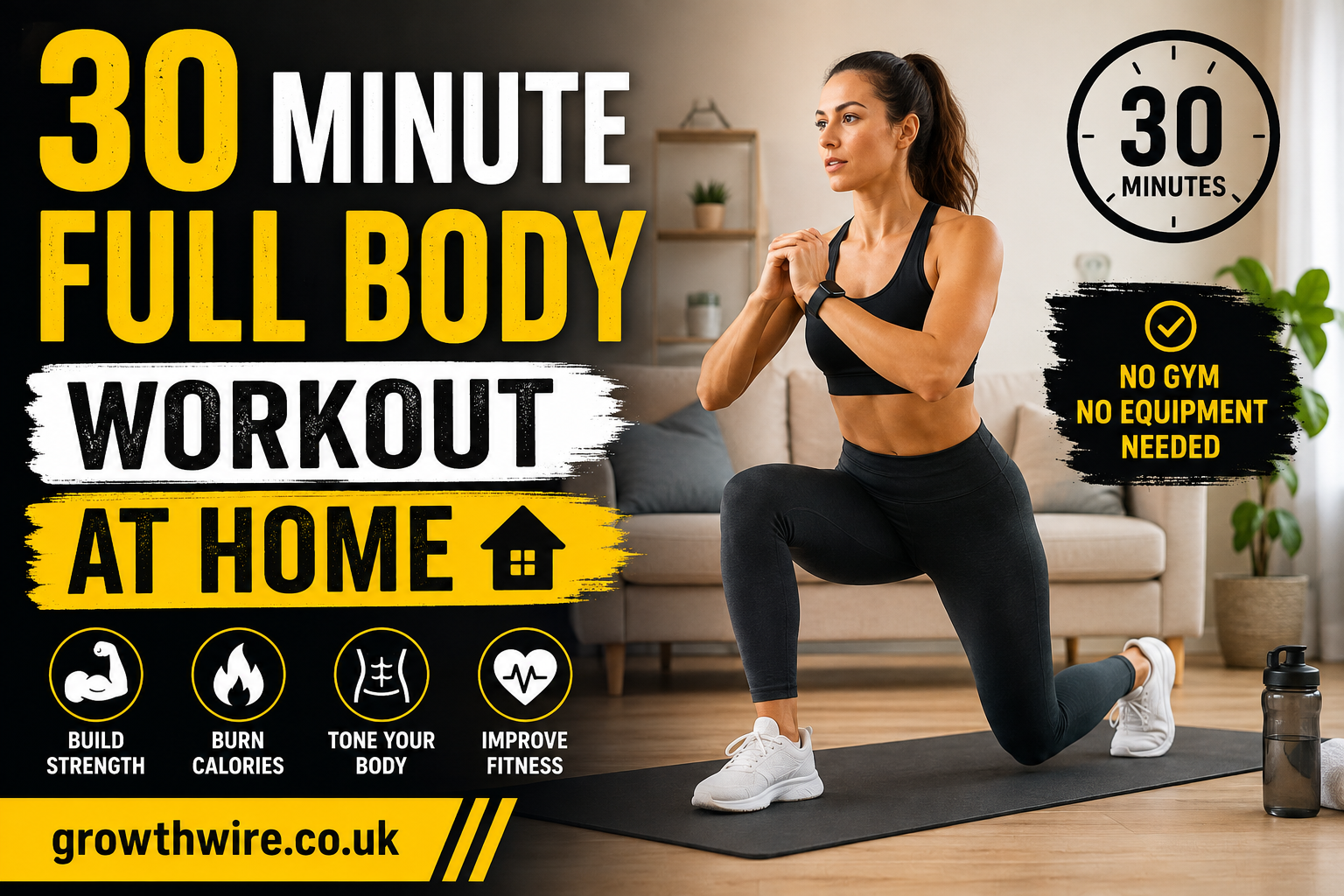
Finding time to exercise can be difficult when work, family responsibilities, commuting, and everyday tasks fill your schedule. The good news is that an effective workout does not always require a gym, expensive equipment, or hours of free time. A well-structured 30 minute full body workout at home can help you train major muscle groups, improve cardiovascular fitness, build strength, and develop better movement habits.
The key is not simply moving for 30 minutes. The quality of the exercises, the order in which you perform them, your technique, and how consistently you train all matter. With bodyweight movements, a small amount of floor space, and a sensible approach to intensity, you can create a practical routine that fits into almost any schedule.
This guide explains how to structure a complete home session, which exercises to include, how to modify movements for different fitness levels, and how to make short workouts progressively more challenging.
Why Try a 30 Minute Full Body Workout at Home?
A short home session offers several advantages. The biggest is convenience. You do not have to drive to a gym, wait for equipment, or spend time changing between machines. You can simply clear a small area and begin.
A full-body approach is also efficient because one workout can involve your legs, chest, shoulders, back, arms, core, and cardiovascular system. Instead of dedicating an entire session to one muscle group, you distribute your effort across the body.
Another benefit is flexibility. You can exercise in the morning, during a lunch break, after work, or whenever your schedule allows. Removing travel time can make regular exercise much easier to maintain.
Short workouts can also be less intimidating for beginners. The idea of exercising for two hours may feel overwhelming, while half an hour is much easier to fit into a normal day.
30 Minute Full Body Workout at Home: What You Need
One of the best things about bodyweight training is that equipment is optional.
For a basic session, you may only need:
- A comfortable exercise mat or carpet
- Enough space to move safely
- A water bottle
- Comfortable clothing
- Supportive footwear, if needed
Optional equipment such as resistance bands, dumbbells, or a sturdy step can provide additional exercise variations. However, you can still create a challenging routine without them.
Before starting, remove objects that could cause you to trip. Make sure the floor is reasonably stable, and give yourself enough room to extend your arms and legs without hitting furniture.
How to Structure a 30 Minute Full Body Workout at Home
A useful 30-minute session can be divided into four parts:
Warm-up: 5 minutes
Prepare your muscles and joints with easy movements.
Strength and conditioning: 20 minutes
Perform several exercises targeting the major muscle groups.
Finisher: 3 minutes
Increase the pace with controlled cardio movements.
Cool-down: 2 minutes
Slow down gradually and perform gentle mobility movements.
This structure gives you enough time to work hard without turning the session into an exhausting marathon.
5-Minute Warm-Up
Never underestimate the value of a warm-up. Starting immediately with demanding exercises can make the session feel unnecessarily difficult.
Begin with about 60 seconds of marching in place. Gradually increase the movement of your arms and legs.
Next, perform approximately 30 seconds each of:
- Arm circles
- Shoulder rolls
- Hip circles
- Alternating knee lifts
- Bodyweight good mornings
- Easy squats
- Gentle torso rotations
- Light jumping jacks or step jacks
The goal is to raise your body temperature and prepare your joints for movement. You should feel more mobile and alert when the warm-up ends, not exhausted.
30 Minute Full Body Workout at Home: Bodyweight Squats
Squats are one of the most useful exercises for a home routine because they train several muscles around the lower body while also challenging your core.
Stand with your feet approximately shoulder-width apart. Keep your chest comfortably lifted and your spine neutral. Bend your knees and hips as though you are sitting toward a chair. Descend only as far as you can maintain good control, then push through your feet to return to standing.
Start with 12 to 15 repetitions.
Focus on smooth movement rather than rushing. Your knees should track naturally in the same general direction as your toes.
Beginner Modification
Use a chair behind you as a target. Lower yourself slowly until you lightly touch it, then stand again.
Advanced Variation
Try squat pulses, jump squats, or slow-tempo squats.
If jumping causes discomfort, stay with regular squats and increase the time under tension instead.
Push-Ups for the Upper Body
Push-ups are a classic bodyweight exercise that can strengthen the chest, shoulders, triceps, and core.
Begin in a high-plank position with your hands slightly wider than shoulder width. Keep your body in a controlled line. Bend your elbows and lower your chest toward the floor, then press through your hands to return to the starting position.
Aim for 8 to 12 repetitions if you are comfortable with standard push-ups.
Easier Options
If a full push-up is difficult, try:
- Wall push-ups
- Countertop push-ups
- Knee push-ups
The objective is to maintain good technique rather than force yourself through repetitions you cannot control.
Harder Option
Slow the lowering phase to three or four seconds. This increases the challenge without requiring additional equipment.
Reverse Lunges for Stronger Legs
Reverse lunges are a practical alternative to forward lunges and can be performed in a small space.
Stand upright with your feet together. Step one foot backward and lower your body while bending both knees. Push through the front foot and bring the rear leg forward to return to the starting position.
Perform 8 to 12 repetitions per side.
Keep your movements controlled. You do not need to lower your knee all the way to the floor.
If balance is challenging, place one hand lightly against a wall.
Why Include Lunges?
Lunges challenge the quadriceps, glutes, hamstrings, and stabilizing muscles. Because you work one leg at a time, they can also reveal differences in balance and control between sides.
Glute Bridges for the Posterior Chain
Lie on your back with your knees bent and your feet flat on the floor. Keep your arms comfortably beside your body.
Press your feet into the floor and raise your hips until your torso forms a comfortable diagonal line from your shoulders toward your knees. Pause briefly at the top, then lower slowly.
Perform 12 to 15 repetitions.
Avoid overextending your lower back. Think about squeezing your glutes and keeping your ribs comfortably controlled.
Progression
Once regular bridges become easy, you can try single-leg bridges or add a pause at the top of each repetition.
Plank for Core Stability
The plank is an efficient way to train the abdominal muscles and other muscles responsible for stabilizing your torso.
Place your forearms on the floor and extend your legs behind you. Keep your body in a relatively straight line. Brace your midsection and breathe steadily.
Hold for 20 to 40 seconds.
Do not allow your lower back to sag. At the same time, avoid pushing your hips excessively high.
Beginner Version
Perform the plank from your knees while maintaining a straight line from your knees through your shoulders.
Alternative
A high plank can be performed with your hands on the floor instead of your forearms.
Mountain Climbers for Conditioning
Mountain climbers combine core stability with a cardiovascular challenge.
Start in a high-plank position. Bring one knee toward your chest, return it, and then bring the opposite knee forward. Continue alternating.
Work for 20 to 30 seconds.
You do not need to move extremely quickly. Beginners can perform slow mountain climbers while focusing on keeping their shoulders stable.
For a higher-intensity version, increase the pace while maintaining control.
30 Minute Full Body Workout at Home: A Sample Circuit
After your warm-up, you can organize the main portion as a circuit.
Complete the following sequence:
- Bodyweight squats — 15 repetitions
- Push-ups — 8 to 12 repetitions
- Reverse lunges — 10 repetitions per leg
- Glute bridges — 15 repetitions
- Plank — 30 seconds
- Mountain climbers — 30 seconds
Rest for approximately 30 to 60 seconds after completing the circuit.
Repeat the circuit two or three times, depending on your fitness level and available time.
Do not worry if you cannot complete three rounds immediately. Two high-quality rounds are more useful than rushing through three rounds with poor technique.
How to Make the Routine More Challenging
Your body adapts when you repeatedly expose it to the same workload. Over time, exercises that once felt difficult may become easier.
You can increase the challenge in several ways.
Add Repetitions
If you comfortably complete 10 push-ups, gradually work toward 12 or 15.
Increase Work Time
Instead of performing mountain climbers for 20 seconds, try 25 or 30 seconds.
Reduce Rest
If your technique remains strong, slightly shorten the recovery period between exercises.
Slow Down
A slower lowering phase can make basic movements significantly more challenging.
Add Resistance
Resistance bands, dumbbells, or a loaded backpack can increase the difficulty of appropriate exercises.
Use More Difficult Variations
Progress from wall push-ups to incline push-ups, then knee push-ups, and eventually standard push-ups.
Progress should be gradual. You do not need to make every workout harder.
Cardio Without Running Outside
You can get your heart rate up without leaving the house.
Useful low-equipment movements include:
- Marching in place
- Step jacks
- Jumping jacks
- High-knee marching
- High knees
- Mountain climbers
- Skater steps
- Fast bodyweight squats
Choose movements that match your fitness level and surroundings.
If you live above another apartment or need to keep noise down, use low-impact alternatives. Marching quickly, stepping side to side, and controlled knee lifts can still provide a useful cardiovascular challenge without repeated jumping.
Low-Impact Version for Beginners
A workout does not need to involve jumping to be effective.
A beginner-friendly circuit might include:
- Chair squats — 10 to 12 reps
- Wall push-ups — 10 to 12 reps
- Supported reverse lunges — 8 reps per side
- Glute bridges — 12 reps
- Bird dogs — 8 reps per side
- Marching in place — 30 seconds
Rest as needed.
The first goal should be consistency and movement quality. Once these exercises become comfortable, increase repetitions or move toward more demanding variations.
30 Minute Full Body Workout at Home for Intermediate Exercisers
If you already exercise regularly, you can increase the intensity.
Try a circuit consisting of:
- 15 squats
- 10 to 15 push-ups
- 12 reverse lunges per side
- 15 glute bridges
- 40-second plank
- 30-second mountain climbers
Complete three rounds if your technique remains strong.
You can also introduce tempo changes. For example, take three seconds to lower during squats and push-ups, pause briefly, and then return to the starting position.
Making Home Workouts Safer
Safety should remain a priority even during short sessions.
Start at an appropriate level rather than attempting advanced movements immediately. Maintain controlled technique, especially when you become tired.
Stop or modify an exercise if you experience sharp pain, unusual dizziness, or symptoms that concern you.
Remember that muscle fatigue and temporary exertion are different from injury-type pain. If you have an existing injury, medical condition, or significant physical limitation, consider discussing exercise choices with an appropriate healthcare professional before beginning a new program.
Hydration is also important, particularly if you are exercising in a warm environment.
The Importance of Recovery
Training is only one part of becoming fitter. Recovery matters too.
Avoid turning every session into an all-out effort. Your body needs time to adapt to training stress.
Adequate sleep, balanced nutrition, hydration, and rest days can support your overall fitness routine.
If you are new to exercise, beginning with two or three full-body sessions per week may be more manageable than trying to train intensely every day.
On other days, you can take walks, perform gentle mobility exercises, or simply allow your body to recover.
How Often Should You Do a 30 Minute Full Body Workout?
The ideal schedule depends on your current fitness level, recovery, and other physical activity.
For many beginners, two or three sessions per week can provide a practical starting point.
For people who already exercise regularly, three or four sessions may fit comfortably into their schedule if intensity is managed appropriately.
Consistency is more important than trying to complete the hardest possible workout once and then stopping for several weeks.
A simple schedule could look like this:
Monday: Full-body workout
Tuesday: Walking or light activity
Wednesday: Full-body workout
Thursday: Rest or mobility
Friday: Full-body workout
Saturday: Optional light cardio
Sunday: Rest
Adjust the schedule based on how your body responds.
Common Mistakes to Avoid
Even a short workout can become less effective when technique and planning are ignored.
Skipping the Warm-Up
Starting immediately with difficult movements can make your body feel stiff and unprepared.
Moving Too Quickly
Fast repetitions are not automatically better. If speed causes you to lose control, slow down.
Using Poor Form
Quality repetitions should come before quantity.
Doing Too Much Too Soon
A beginner does not need an advanced athlete’s workout. Progress gradually.
Ignoring Rest
Rest allows you to maintain better technique and recover between demanding sessions.
Expecting Instant Results
Fitness develops through repeated effort over time. A single workout can make you feel accomplished, but long-term changes come from consistent habits.
How to Track Your Progress
Progress can be measured in several ways besides body weight.
Record the number of repetitions you can perform with good form. You can also track how long you hold a plank, how many rounds you complete, or how much rest you need.
For example, you might begin with:
- 8 push-ups
- 12 squats
- 20-second plank
- Two circuit rounds
After several weeks, you may be able to complete:
- 12 push-ups
- 18 squats
- 40-second plank
- Three circuit rounds
That is meaningful progress even if the scale has not changed.
You can also pay attention to everyday improvements, such as climbing stairs more comfortably, feeling stronger when carrying groceries, or having more confidence during physical activities.
Can 30 Minutes Really Be Enough?
Thirty minutes can be enough to make exercise worthwhile, especially when the session is organized effectively.
The goal is not to prove that a short workout is always better than a long one. Rather, a 30-minute session can be a realistic option for people who struggle to find larger blocks of time.
The combination of resistance movements, core exercises, and moderate cardio can provide a balanced session.
However, your overall activity level matters. A workout should complement healthy daily movement rather than replace it entirely.
Walking regularly, reducing prolonged sitting, staying active throughout the day, and participating in activities you enjoy can all contribute to a more active lifestyle.
Nutrition and Hydration Considerations
Exercise works alongside nutrition rather than separately from it.
A balanced diet can provide the energy and nutrients your body needs for daily activities and training. Aim for a variety of foods, including vegetables, fruits, whole grains or other carbohydrate sources, protein-rich foods, and healthy fats.
Drink fluids regularly, particularly before and after exercise and when temperatures are high.
You do not necessarily need special sports products for an ordinary 30-minute home session. For many people, regular meals and adequate hydration are sufficient.
A Simple 30-Minute Routine You Can Save
Here is a straightforward version of the workout:
Minutes 0–5: Warm-up
March in place, arm circles, hip movements, easy squats, and step jacks.
Minutes 5–10: Lower body
Squats and reverse lunges.
Minutes 10–15: Upper body
Push-ups and plank variations.
Minutes 15–20: Glutes and core
Glute bridges and bird dogs.
Minutes 20–27: Conditioning circuit
Alternate mountain climbers, squats, marching, and step jacks.
Minutes 27–30: Cool-down
Walk slowly around the room and perform gentle stretches.
This is only a template. You can modify the exercises, repetition ranges, and intensity according to your abilities.
Final Thoughts on a 30 Minute Full Body Workout at Home
A 30 minute full body workout at home can be an effective way to make exercise part of a busy lifestyle. You do not need a commercial gym or complicated equipment to train the major muscle groups and challenge your cardiovascular system.
The most important factors are consistency, appropriate intensity, good technique, and gradual progression. Start with movements you can perform confidently, modify exercises when necessary, and increase the challenge only when your body is ready.
A half-hour may seem small compared with a long gym session, but repeated consistently, those minutes add up. The best workout is often the one you can perform regularly and sustain as part of your everyday routine.
Whether you are a complete beginner or already active, a thoughtfully designed home session can give you a practical foundation for strength, mobility, conditioning, and general fitness. Start where you are, focus on quality movement, and let your progress build over time.
